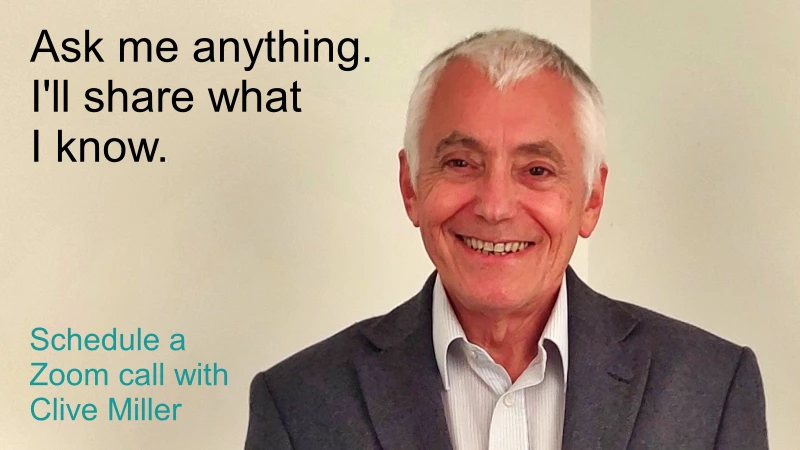
Positive Change Enablers podcast transcript. Julia Feng is interviewing Clive Miller.
Julia: Hello everyone. Thank you for watching or listening to the Adaptive Edge podcast. Today our guest is Clive from the UK. Clive is a very long-time friend from 20 years ago. At that time, I was running my Shanghai training company, and I invited him to deliver an enterprise sales training program for clients in Shanghai and Beijing.
So, Clive, thank you for accepting the invitation to the podcast. Would you like to introduce yourself a little bit more?
Clive: Yes. Thank you, Julia. It's great to be speaking with you again, and thanks for the opportunity. I started my business in 1996 after a 17-year sales career and ended it working for a company called Silicon Graphics, looking after a team of 28 people. That was my sales career. Ever since then I've been um operating SalesSense as a boutique consultancy. Occasionally we've had a few people involved, but now it's almost entirely me uh with a bit of support from siblings and my wife. We are still helping people who sell complex things to other businesses with sales structure, sales skills and so on.
Julia: Your sales training is more related to more complex selling, right? Selling to enterprises, big companies. So you must have lots of experience facing complex situations or going through change in the past 20 years. So could you please share with us one story where you have gone through a complex situation or change?
Clive: Yes, change complexity. There are so many situations I could talk about. I tried to scale the business several times, and one particular occasion was when it all fell in a heap, and I ran out of money or very nearly ran out of money. That was quite complex. Ultimately, I kept going, and I'm still running the business now. In between times, I did have an employed job. I did sales enablement for Blackboard for three and a half years up till about 2014. It's been quite a ride. If I started again, I'd probably do it differently. It's easy to think so with 2020 hindsight. I don't know if that's a sufficiently complex situation. It seemed complex and difficult for me at the time. I had three or four employees, part-timers and half a dozen, four or five associate consultants. So the organization had got larger and we were we were growing but I was burning into my cash faster. I ended up sinking about 400k into the effort to scale the business, and it wasn't enough. I completely underestimated what it would take to turn a boutique, which was really just me and my wife, into a proper sales training business. I learned plenty of ways not to do it.
Julia: So, you think you would do it differently, right? How long did it take you to go through this
complex situation?
Clive: It started after the twin towers came down in the US. Two or three contracts were cancelled, not because of anything I did, just because of the circumstances. Nobody knew what was happening. You asked about complexity and that was when I first came to learn about something called VUCA, which is a term invented by some American consultants in 1987. It stands for volatile, uncertain, complex and ambiguous. When you asked the question about complexity, it brought that to mind. So um after the Twin Towers came down I had to restart and make a new plan. I borrowed a chunk of money against my home and tried to make the thing into a real business. But as I've said, it didn't really work out. Burnt through the cash and then had to stop. So um that's how it came about.
Julia: So when you were in that situation, and you kept going...
Clive: There's a great saying "If you find yourself in hell, keep going".
Julia: So you kept it going and what was really behind it? What kind of strength supported you to keep going?
I'm not sure it was strength. I mean, you do what you can. You face what comes at you. For me, in life, I just face what's in front of me and get on with it. There are ups and downs. I've always been a fan of Rudyard Kipling's poem, If. I don't know if you're familiar with it; it sounds a bit trite when you recite it in a situation like this: "If you can face both triumph and disaster and treat those two imposters just the same." That's one of the lines in the poem. The poem's not very long.
Julia: Yes, please do recommend. I will include it in the description. Then people can also read it.
Clive: It is called 'If' by Rudyard Kipling. It's very old, so you can find copies online.
Julia: So you said if you look back, you probably would do something different. What kind of different business would you do?
Clive: Companies call in outsiders and contractors when things are going well rather than when things are going badly. When perhaps a consultant, training course or coaching can make more of a difference. When things are bad, people tend to be pulling in their horns and reducing discretionary spending. That means cutting some marketing and sales training. You probably still have to do product or technical training, but you don't have to do sales training. There are certain marketing things you don't have to do. And people tend to stop doing those things when it when money is tight. So as economies rise and fall, we all go through recessions from time to time, and businesses like mine starve. That has been my experience anyway.
If I were to start over again, I think I would try to get into a business that was a bit more consistent, where people needed what you sell all the time, not just when things are going well. Oh yeah.
So why do people do sales training? There are a few reasons. One of them is, "We haven't done anything for a year. Better do some sales training." Another one is, one or two people on the team are not doing so well and rather than manage it, manage the process, which is the right thing to do as I'm sure you're aware being a leadership trainer, so then they put everybody on a course. Quite often, people put teams on training courses without explaining to them either why they're doing it or what they want them to do differently as a result.
There is a process that we use to try and compensate for it by fulfilling those aspects of a training initiative before delivering the training. It doesn't always work out in terms of people knowing what they're expected to do differently and accepting it and being willing and wanting to change.
Julia: Yes. I totally agree with you. I've been in the training industry for almost 20 years now, and many deliveries have moved online. In a virtual room, we found that people come in and go during sessions. They don't focus, yet companies are spending lots of money on their leadership training.
Recently, some Philippine businesses in the industrial zone closed their factories because of no sales when they didn't have any qualified salespeople to bring in sales. So, they had to close the whole factory.
Clive: In the technical world that happens a lot where a company is built on some clever technology. It's technology-led. The founders get some business, and the enterprise gains some momentum without a sales force. Then at some point the momentum slows. I had a session recently with a group of project managers aiming to do some selling. I think it was more a case of wanting to do sales part-time to re reignite the growth for their organisation. I think it became increasingly clear that it's not a part-time job.
Julia: Yes, some factories, they relied on their head office sales force. They didn't develop a local sales force. So when the head office didn't get contracts for them, they ended up with no orders.
Clive: When it becomes apparent that the pipeline has run dry, it's too late because you can't turn on sales overnight. People expect to get a step change, but it doesn't happen like that. It's a long game.
Julia: Yes. Especially in B2B sales, the sales cycle seems to be much longer - 200 days, even the whole year you are building the pipeline.
I know your training is called enterprise selling and is especially for handling complex sales. Would you like to say a little bit more about how to make complex selling successful?
Clive: 'Forethought, planning, and preparation' is the short version. The higher the value of the sale, the more people are going to be involved in it both within the customer's organisation and your organisation as a seller. So the job of the salesperson is much more like project management because you've got two herds of cats and you're trying to make them work together all the way to the point where they can get agreement and everybody signs a contract and the sale happens. And as you said, in the case of high-value sales, it can take multiple years. With just moderately complex sales, it's typically 3, 6, or 9 months. It's really important to be able to think ahead. It's much less dependent on individual communication skills. Just being a good presenter is not enough. You've got to be able to organize people who don't report to you in your own organisation and people in your customs organisation and cause them to work together.
Julia: Yes, so how does your training help your client either speed up the process or prevent something bad happening?
Clive: The number one thing is the opposite of what you'd expect to want to do as a salesperson. Typically the conversation goes, "We address these problems. Have you got those problems?" And if there's some possibility that they have got those problems then there's presentation and information transfer and so on. Whereas it shouldn't be that way around.
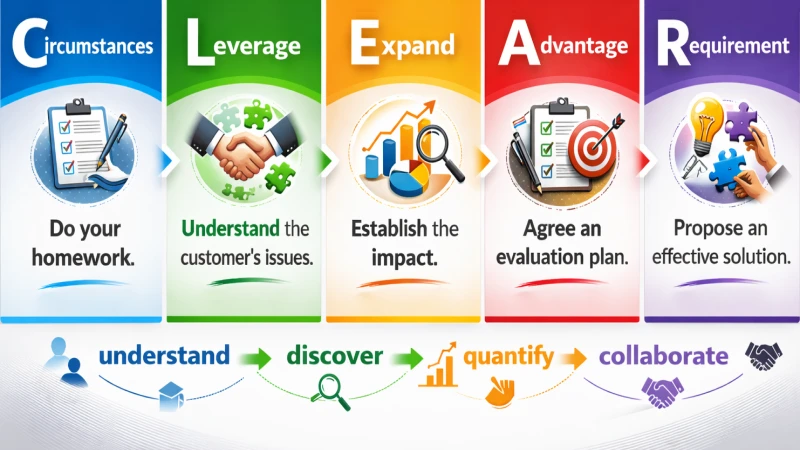
I teach something called CLEAR, which is Circumstances Leverage Expand Advantage Requirement and the Requirement is always on the back end. It starts with three rules, which are: first, make no assumptions, which is really difficult to do because when you start talking about a solution, you're immediately making a whole range of assumptions about whether the problem is real, or that they have to do something about it, for example. The second rule is to declare your intent to make no assumptions, which is easy to do, but nobody does it. If you said in a sales conversation, "I'd like to try and avoid making assumptions through this process; is that okay?" nobody is going to say, "No, I want to make assumptions." So your agreement on that gives you a kind of a ledge you can get back to when they say don't worry about the money or you don't need to talk to those people or whatever else. The third rule is don't talk about the solution because as soon as you talk about the solution, you've given up the only reason they have for talking to you. They say "Great, that's what we hoped you'd say" and "Can you put it in writing? Send us something." And then they get on with their internal process, which as we've said could take years. Their silence doesn't necessarily mean that you've lost, but you keep following up and saying, "Have you made your minds up yet?" or with more subtlety, but it means the same thing. And they say, "Uh, no, not yet." And after three calls, they don't take the calls anymore because you just want to ask the same thing and they don't know. They don't have an answer for you. As I said, it doesn't mean to say you've lost, but it does mean uh that there's no dialogue. I call it the black hole.
You must get all the information out before you give up your information and talk about the requirement. It's so difficult because they don't want to talk about their pain, their soft underbelly, what Steven Covey called it. They don't want to talk about their soft underbelly, and it's awkward, so you don't really want to talk about it either. You want to talk about your solution, which is what you know most about. So there's a collusion between the customer and the seller to talk about the solution, and that jumps over all these assumptions, such as who the people impacted by this are and do they all think the same thing - nobody ever does; people have different ideas about complex things. The CLEAR process is about slowing down and making sure you get that information out while you've still got something to trade with, which is your willingness to prepare a proposal, ultimately. So salespeople are mostly much too eager because the request for information seems like an expression of interest. So they're much too eager to give up their information, whereas what they should be doing is to ask, "Is it real?" "Have you got the numbers?" They probably haven't got the numbers. So ask, "Is it important?" "Should we stop?" "Can you get the numbers by yourself?" Slow the process down until you get all the details you need, which includes all of the people who are impacted by whatever it is that's going on, and then you've got to negotiate talking to them all, because if you end up with a single point of contact, you don't know if you're being lied to or not. Oh, customers don't lie. Of course not, do they? They don't lie as such. But do they mislead salespeople? Well, you can mislead salespeople and still go to heaven. So salespeople get misled all the time. So, slowing the process down with the three rules and CLEAR is essential for a complex sale. Once you've sent them all the information and nothing's happening it's really hard to go back in and say, "I forgot to ask you some important questions. Can we have another conversation?" It doesn't work like that, right? You've missed the chance. The only time to do it is before you give up your information.
Did that answer your question?
Julia: Yes. Very insightful. I'm having a very quick condensed sales training course from you right now. I'm getting flashbacks of how I do in sales because I also do selling sometimes. I also encounter the challenge of working with bigger companies taking so long. I lose patience sometimes. I think certainly your training, your methodology, the approach you accumulated for so many years is very helpful for people.
If you are going to say something to a young salesperson, man or woman, and they're at the start of their career, what would you say to them?
Clive: Read more or listen more if you if you prefer. I listen to a lot of books because I find it easier to do that at the same time as exercising. So if I'm walking or driving, I'm listening to an audiobook. I'd say read more. If people can teach themselves, they don't need people like me to help. The information is all out there. Generally, there aren't any shortcuts.
The thing that helped me most as a young salesperson was listening to audiobooks or audio tapes, as they were back then. I think I was lucky to have a couple of good sales training courses quite early. I remember my first one was called K Training. I think it still exists. It was based on teachings by an Austrian called Gustaf Kaser. So, that might help you pin them down, if you can work out the spelling. A recommendation from a sales trainer for another sales training firm!
Julia: So listen more and read more. For handling complex selling, you have to have very good observation skills to observe all the stakeholders, how they speak, how they frame things. And emotional control is important, don't you think?
Clive: Yes, there are a lot of interpersonal skills that I think are a prerequisite. We teach those things as well, as you do in leadership training, I'm sure. I have courses just focused on interpersonal communication. The hard part is getting to speak to all the right people. Once you get over that hurdle and if you've got a series of questions to ask, which is what we teach in the CLEAR process, then you have to go around and talk to all of those people individually. There's a set of questions to ask them to figure out whether you've got something going or not.
Having an understanding of psychology, personality, and listening. Listening is essential. A lesson from my early years. In my first sales job, I was selling Intel components for a distributor. I didn't feel I was a competent electronics engineer. To get past this, because I was going to see R&D managers, electronics engineers, and the like, I would ask them what they were working on, prompt them with a few questions, then shut up and listen. It worked really well for me. If I listened well enough, they would tell me everything I needed to know about what they wanted, when they were going to buy it, how much they needed to pay and so on. I was lucky, I guess. So listening, yes. Very important.
Julia: Yes, I remember my first job was as a saleswoman for real estate, and I told my manager I don't think I will be a good salesperson, and then my manager said no, actually, you should be a good salesperson because you're good at listening. So, that helped me clear the hurdle. I thought a salesperson has to be really good at talking, which is my husband!
Clive: How is Ramil?
Julia: Very good. He's doing well and setting up a new cooperative here.
Clive: That's great.
Julia: Thank you, Clive. I think in a very short time I have grasped a lot of your interests.
Clive: There's lots more. You said to mention some books. I haven't had books published by others, but I have three fairly substantial PDFs I call books. There's the Sales Professional Toolkit, which I offer for £10. There's the Sales Success Formula, which I give away for nothing. It describes how to build a high-performing sales team or how to become a high-performing salesperson. And The Power to Speak in Public, which is something I've been rewriting. I wrote the original 30 years ago, and the new version is now complete.
Julia: Okay. Very good. Please do provide the links so people can download it if it's free. That'll be a good resource for them.
We are in changing times again with AI. How does that affect you, and what is your approach to AI?
Clive: Oh great question. There are about five or six articles on my website about AI. Does AI take sales jobs and so on. I won't try to reiterate them here. I use AI every day. Somebody asked me this question the other day. I use it for tech support. I use it for improving my content. I use it for producing pictures. I think ChatGPT is more versatile than Claude. People say Claude's better. I don't know. I only use ChatGPT. That gives me the ability to create images, diagrams and pictures professionally without actually hiring, uh sorry, I don't mean to discourage people who are good at that sort of thing. It has just freed me up to create images and pictures very easily. I use it for renovating old pictures in the family archive as well, so I'm usually using ChatGPT every day. I think it's amazing. There are scary stories, though. There's a book I listened to, If Anybody Builds It, We All Die. And it was by very serious people who know what they are talking about. There are some serious risks as we've seen in the press recently. I don't think we are going to stop because of the competition to get better. The better the AI, the more productive the people using it are going to be. So there's a serious competition and vast amounts of money being invested in it. Maybe the West has got a slight edge in the AI race at the moment, but the East has the edge in robotics by a wide margin. You would have seen the news on the Chinese robot Olympics recently. I can't remember the numbers exactly, but I think Tesla has shipped something like 150 humanoid robots and the Chinese firms have shipped something like 5,000. So, the future is unclear. The future is definitely VUCA. Although the term was invented in 1987 to address the collapse of the Soviet Union, it is even more applicable today. Things are more volatile, more uncertain, uh more complex and more ambiguous.
Julia: Yes, I agree. Totally. Yes. So, I think how do we deal with it?
Clive: We have to press on, don't we? I mean, there were doomsayers about every other major technological advance in the past. Nobody knows what's going to happen. We feel our way forward.
Julia: Yes, I agree. Actually, I'm going to use Claude to finish the production of the podcast. So, I've been using Claude a lot. So, I think it's useful. It really empowers me to do what I want to do. So, yes, I agree. It makes you much more effective, doesn't it, as a person?
Clive: Yes.
Julia: Okay, great. Thank you, Clive. I learned a lot from you, and it's really nice to catch up with you again after 20
years. I hope we don't have to wait that long anymore. Just keep in touch anytime.
Clive: Yes. we should we should speak more often. Definitely.
Julia: Yes. Thank you. Thank you, Clive. Thank you for your time.
Clive: Thank you. Thanks very much for the opportunity, Julia.
Links mentioned in the interview:
The CLEAR process article.
The Sales Professionals Toolkit ebook (£9.95).
The Sales Success Formula ebook - free
The Power to Speak in Public ebook - free
If you are interested in Positive Change Enablers or any of the topics discussed in this interview, we will be pleased to help. Telephone +44 (0)1392 851500. Alternatively, send an email to info@salessense.co.uk or use the contact form here.