Leading Sales Teams in the Age of Intelligent Tools
AI for sales management means using artificial intelligence to analyse sales activity, improve coaching, and guide decision-making. It presents an unprecedented opportunity to remove the guesswork associated with sales leadership. The role of the sales manager is shifting from supervision to data-driven performance leadership.

Artificial intelligence is changing how selling happens. AI now writes prospecting emails, analyses call recordings, predicts which deals are likely to close, and identifies the behaviours that correlate with winning business. Tasks that once consumed hours of a sales manager’s time can now be completed automatically in seconds.
But this does not mean sales managers are becoming obsolete.
Quite the opposite.
As explored in our cornerstone article, Will AI Replace Salespeople?, the real impact of AI is that it removes routine activity and exposes what genuinely creates value in selling. The same shift applies to sales leadership.
Sales managers who adapt to AI will become more strategic, more analytical, and far more effective coaches. Those who do not will find their traditional management methods increasingly irrelevant.
The question we should all be asking is "How should sales managers evolve to lead AI-enabled sales teams?"
Studies suggest that a large proportion of B2B sales organisations are integrating AI-guided selling into their processes. Cited in Sales Process Proof.
The Changing Role of the Sales Manager
Historically, sales management involved a mixture of supervision, reporting, and occasional coaching. Managers spent time reviewing pipeline reports, listening to random call recordings, chasing CRM updates, producing forecasts, and reacting to problems. Much of this work existed because information was incomplete or delayed.
AI fundamentally changes that.
Modern sales platforms analyse conversations, identify patterns across thousands of conversations, and highlight risk signals automatically. Instead of guessing which behaviours lead to success, managers using AI call analysis tools can now see the data.
This means the manager’s role shifts away from information gathering and towards performance leadership. In other words, the job becomes less administrative and far more strategic.
| Traditional Sales Management | AI-Enabled Sales Management |
| Manual pipeline reviews | AI-driven deal analysis |
| Random call listening | Automatic conversation analytics |
| Activity monitoring | Behaviour pattern recognition |
| Reactive coaching | Data-guided coaching |
Five Ways Sales Managers Must Adapt
1. Move From Inspection to Coaching
Traditional sales management often focused on inspection. Managers checked CRM records, reviewed pipeline numbers, and monitored activity levels. AI systems now do this automatically. They can analyse sales calls, identify talk-to-listen ratios, highlight missed buying signals, and flag deals at risk. This frees managers to spend less time inspecting data and more time helping people develop.
The AI augmented sales manager has more time for coaching, mentoring, and capability building.
AI can highlight what went wrong in a conversation. It takes a skilled coach to help a salesperson do better in future calls.
2. Use Data to Improve Coaching Quality
One of the biggest weaknesses in traditional sales management has been subjective coaching. Feedback was often based on impressions rather than evidence. AI changes this by analysing patterns across conversations, deals, and buyer interactions.
Managers can now identify which discovery questions lead to deeper engagement, which behaviours correlate with winning deals, and where individual sellers struggle in the sales process.
Feedback is based on objective data, rather than subjective recollections. Coaching can become more precise and personalised. Instead of generic advice, managers can address specific behavioural gaps.
Research suggests AI-assisted insights can significantly improve how managers guide salespeople and improve team performance.
3. Develop AI-Literate Sales Teams
Many salespeople are already experimenting with AI tools. They use them to draft outreach emails, research prospects, summarise meetings, and generate proposals. The intelligent use of AI tools creates an advantage. Sales managers who develop AI literacy within their teams give them an edge over those who don't.
AI literacy is based on knowing when AI is helpful, when human judgement is essential, how to verify AI-generated insights, and how to integrate AI into one's workflow.
Managers who embrace this responsibility develop AI-augmented sales professionals.
4. Focus on Human Skills AI Cannot Replace
AI excels at analysing data and automating routine work. It does not excel at building trust, navigating political decision environments, resolving ambiguity, or managing complex stakeholder dynamics. These capabilities remain deeply human. As AI automates administrative tasks, human sales skills become even more important.
To complement AI advantages, sales managers need to ensure their teams develop human strengths in:
- discovery conversations
- problem framing
- negotiation
- influencing multiple stakeholders
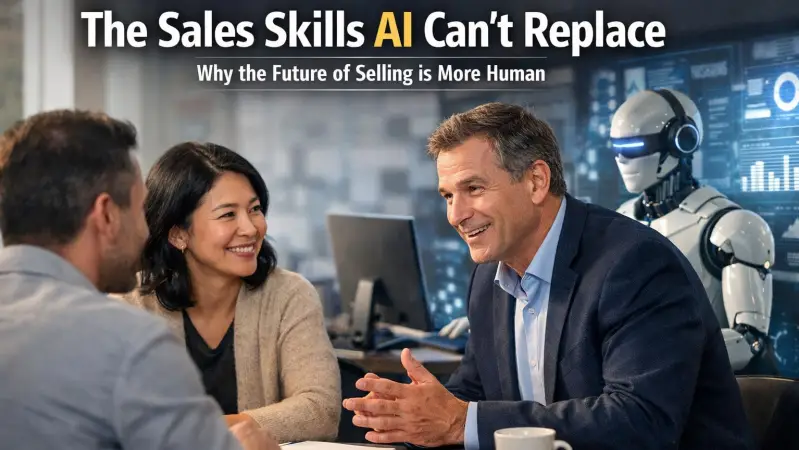
These are precisely the skills explored in our related article, The Sales Skills AI Cannot Replace.
5. Lead Organisational Change
Technology alone never transforms a sales organisation. Leadership does. Many companies adopt AI tools but fail to realise their potential because teams do not trust the data, sellers ignore the insights, and processes remain unchanged.
Studies show that organisational factors such as change management and leadership are often bigger barriers than the technology itself. Sales managers play a vital role in encouraging adoption, modelling AI-enabled workflows, aligning processes around new insights, and reinforcing behavioural change.
Today's sales managers must lead transformation.
If the other guy is getting better, then you'd better be getting better faster than the other guy is getting better... or you're getting worse. Tom Peters.
The Emerging Model: AI-Augmented Sales Management
The future of sales management is not human versus machine. It is human plus machine. AI provides analysis, pattern recognition, predictive insights, and administrative automation.
Sales managers lead change, provide judgement, facilitate or deliver coaching, and create cultural direction.
When these two capabilities work together, the result is a far more powerful system than either could achieve alone.
Research into AI coaching suggests that humans still play a critical role in strengthening salespeople’s confidence and translating feedback into practical development. The most effective organisations combine AI insight with human leadership.
The Strategic Opportunity for Sales Managers
Every technological shift changes which capabilities matter most. In the AI era, the most valuable sales managers will be those who can interpret AI insights, translate data into coaching, develop stronger sales skills in their teams, and lead the adoption of new tools and processes. The role becomes more demanding but also more valuable.
AI does not remove the need for sales leadership; it raises the standard.
FAQ: AI for Sales Management
How should sales managers use AI?
Sales managers should use AI to analyse sales activity, identify patterns in winning deals, and improve coaching. AI tools can review sales calls, flag deal risks, analyse pipeline health, and highlight behaviours that correlate with success. The manager’s role is to interpret these insights and use them to guide salespeople’s development and decision-making.
Will AI replace sales managers?
No. AI can analyse data and automate administrative tasks, but it cannot replace leadership, judgement, or coaching. Sales managers remain responsible for developing people, guiding strategy, and managing complex customer situations. In practice, AI makes strong sales leadership more valuable, not less.
What AI tools do sales managers use?
Sales managers increasingly use AI tools embedded in CRM and revenue platforms. These include conversation intelligence software that analyses sales calls, forecasting tools that predict deal outcomes, and AI assistants that generate summaries, insights, and recommendations. The goal is not automation alone, but better visibility into how sales performance is created.
How does AI improve sales coaching?
AI improves sales coaching by analysing large numbers of sales interactions and identifying patterns that lead to success or failure. Managers can see which questions drive better discovery, where deals typically stall, and how top performers behave differently. This allows coaching to become more specific, data-driven, and effective.
What skills do AI-enabled sales managers need?
AI-enabled sales managers need a combination of analytical and human leadership skills. They must be able to interpret data, understand how AI tools work, and integrate insights into sales processes. At the same time, they must continue to develop human capabilities within their teams such as trust-building, negotiation, and complex decision support.
Conclusion
Artificial intelligence is reshaping the mechanics of selling, yet it does not eliminate the need for leadership. If anything, the opposite is true. As AI automates routine tasks and exposes performance patterns, the impact of good sales management becomes more visible than ever.
The sales managers who thrive in the AI era will be those who use it to become better strategists, better leaders, and better sales team architects. In doing so, they will build sales teams that are not replaced by AI but augmented by it.
Article by Clive Miller. Arrange a conversation or call +44 1392 851500.
Clive Miller is a UK-based sales consultant, trainer, and coach with over 30 years’ experience helping B2B organisations improve sales performance and decision-making effectiveness.
Related Resources:
- Changing Behaviour
- Sales Optimisation
- Sales Process Proof
- Sales Performance Improvement
- Sales Coaching
- B2B Sales Trends
- The Perfect Discovery Sales Call
Do you use AI for sales management? Are you building an AI-enabled sales organisation? If you need to make better use of AI for leading the sales function or managing sales teams, we can help through leadership coaching, sales process optimisation, and AI-supported sales enablement. Schedule a consultation or call +44 (0)1392 851500. Alternatively, use the contact form here or send an email to jimm@salessense.co.uk.