Why the Future of Selling Is More Human — Not Less
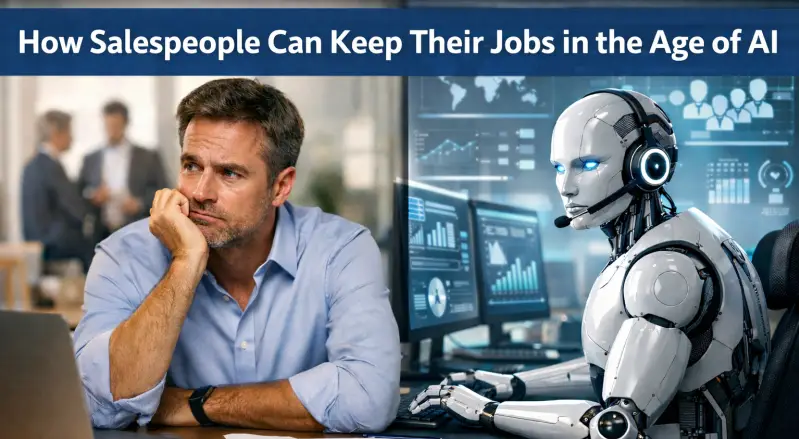
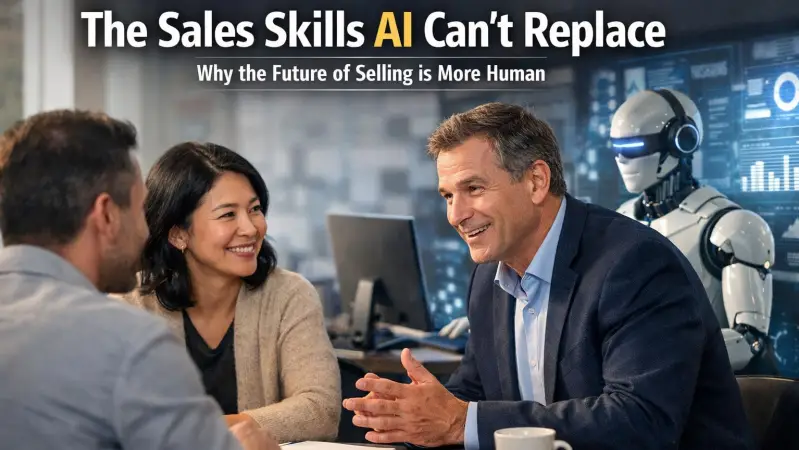
Artificial intelligence is already transforming sales, so what are the sales skills AI cannot replace?.
It writes emails, analyses calls, scores leads, drafts proposals, predicts buying intent, and automates follow-ups faster than any salesperson ever could. Much of what once filled a salesperson’s day is now handled by algorithms.

Which raises an obvious question, and the one explored in our cornerstone article:
👉 Will AI replace salespeople?
The short answer is no.
But the longer, and more important, answer is this:
AI is not eliminating sales skills. It is exposing which ones actually matter.
As automation removes routine activity, the competitive advantage shifts decisively toward capabilities that remain fundamentally human. This article explores the sales skills AI cannot replace, and why they are becoming more valuable in the AI era.
The Paradox of AI in Sales
AI excels at tasks that are:
- repeatable
- data-driven
- pattern-based
- scalable
That includes prospect research, CRM updates, messaging drafts, and analytics. But research consistently shows a paradox emerging. As AI adoption increases, authentic human connection becomes the real differentiator. When every seller has access to the same tools, technology stops being an advantage. Human capability becomes the only advantage.
In fact, studies suggest many lost deals could have been won through better human selling experiences, not better data, stronger solutions, or a lower price.
1. Building Trust (Not Just Providing Information)
AI can deliver answers. Salespeople create confidence. Buyers rarely struggle because information is unavailable. They struggle because decisions are risky.
In complex B2B purchases, customers ask questions like:
- “Is this the right decision?”
- “Will this work for us?”
- “What happens if we get this wrong?”
AI supplies options. Humans reduce uncertainty.
Trust emerges from:
- credibility built over time
- perceived intent
- emotional reassurance
- shared accountability
Even AI-driven organisations acknowledge this limitation. Salesforce’s CEO argues that sales still depend on human connection and face-to-face engagement that AI cannot replicate.
Trust is not data transfer. It is a psychological state, and psychology remains human territory.
2. Deep Discovery and Problem Framing
AI is excellent at answering questions. Great salespeople ask better ones. Professional selling is not about uncovering needs already understood by the buyer. It is about helping customers recognise problems they have not yet fully articulated.
This requires:
- curiosity
- contextual judgement
- reframing assumptions
- adaptive listening
Researchers note that human sellers add value by challenging customer thinking and guiding complex decisions, particularly in high-stakes buying situations. AI analyses patterns from the past. Humans interpret ambiguity in the present. And complex sales live in ambiguity.
3. Emotional Intelligence and Empathy
As automation grows, emotional intelligence becomes more, not less, important. McKinsey-aligned research shows that empathy, critical thinking, and complex problem-solving rise in importance as routine tasks are automated.
Why?
Because buying decisions are emotional long before they are rational.
Customers evaluate:
- perceived risk
- personal reputation
- internal politics
- fear of failure
- confidence in change
AI can simulate empathy linguistically, but empathy in selling involves sensing hesitation, adapting tone in real time, recognising unspoken concerns, and responding authentically
These rely on lived human experience — not prediction models.
4. Navigating Human Complexity and Buying Groups
Modern B2B decisions rarely involve one buyer; they involve committees. Stakeholders disagree. Priorities conflict. Politics intervenes.
One critical human skill is consensus building, aligning different people around a shared decision. AI struggles here because organisational dynamics are messy, emotional, and often irrational.
Human sellers act as:
- translators between departments
- mediators of competing agendas
- facilitators of agreement
In other words, they manage people, not just information.
5. Judgement Under Uncertainty
AI predicts based on historical probability. Sales often require acting despite incomplete data.
Research from Harvard Business School highlights that human judgement remains essential because AI cannot reliably distinguish strong ideas from mediocre ones or guide long-term strategic choices alone.
Top salespeople recognise:
- when to push or pause
- when price is not the real objection
- when timing matters more than features
- when a deal should be walked away from
These decisions rely on intuition built through experience, something models approximate but do not truly possess.
6. Negotiation and Value Creation
Negotiation is not merely optimisation; it is perception management. AI can calculate optimal pricing scenarios. Humans negotiate meaning, fairness, and relationship outcomes.
Successful negotiation involves:
- reading emotional signals
- managing ego and status
- reframing concessions
- preserving long-term trust
These elements depend on human psychology — not calculation.
7. Creativity and Co-Creation
In complex sales, solutions are often invented during the conversation.
Customers frequently do not know exactly what they need until dialogue unfolds. Researchers studying AI and selling note that humans remain essential for co-creating solutions around customer pain points, something AI struggles to replicate independently.
Creativity in sales emerges through interaction:
idea → reaction → adjustment → insight
This collaborative emergence is inherently human.
8. Motivation, Coaching, and Change Leadership
Buying is change, and change is emotional. AI can coach process consistency, but neuroscience research shows human coaching remains essential for motivation, emotional engagement, and behavioural growth. The same applies to customers.
Salespeople help organisations overcome inertia, build internal momentum, and maintain belief during implementation
Technology informs change. Humans lead it.
What Remains Human? Some analysts now describe sales work roughly as:
20% AI-only tasks (automation and data handling)
20% AI + human collaboration (insight and preparation)
60% are the human-only activities of listening, discovery, negotiation, and trust-building.
In other words, AI removes administrative selling and leaves behind real selling. The real shift is from activity to value.
Historically, many sales roles were built around activity:
- sending emails
- gathering information
- producing proposals
- chasing follow-ups
AI now performs these faster and cheaper, so the profession is evolving. The future salesperson is less of an information provider, product explainer, or process administrator and more:
✅ decision guide
✅ problem thinker
✅ trusted adviser
✅ change facilitator
The New Competitive Advantage
AI will not replace salespeople, although it will replace salespeople who rely only on tasks AI performs better. The winners in the AI era will be those who develop distinctly human capabilities of:
- judgement
- empathy
- insight
- trust creation
- strategic thinking
- conversational intelligence
Technology raises the baseline. Human skill determines the outcome.
Final Thought: AI doesn’t end selling, it reveals it. For decades, selling has been partially hidden beneath administration and process. AI is stripping that away. What remains is the core truth of professional selling:
People do business with people who help them think clearly, decide confidently, and change successfully. AI can assist that process, but it cannot be that process. And that is why the future of sales belongs to augmented humanity rather than artificial intelligence.
Article by Clive Miller. Arrange a conversation or call +44 1392 851500.
Clive Miller is a UK-based sales consultant, trainer, and coach with over 30 years’ experience helping B2B organisations improve sales performance and decision-making effectiveness.
Related Resources:
- Changing Behaviour
- Sales Performance Improvement
- Sales Coaching for Decision Partner Capability
- Selling with Integrity
- The Perfect Discovery Sales Call
Do you have the sales skills that AI cannot replace? If you need to develop important sales skills, we can help. Schedule a consultation or call +44 (0)1392 851500. Alternatively, use the contact form here or send an email to jimm@salessense.co.uk.