Use our facilitated enquiry sales process improvement method to bring about rapid transformation in sales practices and results.
Sales Process Improvement Facilitated Enquiry is a structured method for evaluating organisational effectiveness against established or commonly understood best practices.
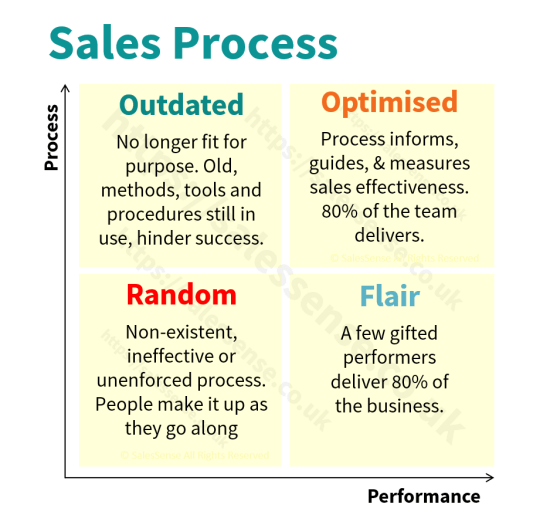
Is your sales process letting you down?
Are these situations familiar?
- Feast and famine performance
- Deals that stall without clear reasons
- A pipeline that looks strong but doesn’t convert
- Erratic or unreliable forecasts
- Disagreement about what to do next
These are all symptoms of a weak or poorly defined sales process. This aspect of sales improvement is often neglected. Many salespeople resist the idea of a formal process because it feels restrictive or artificial. So instead of imposing changes on them, involve them directly in defining how the sales process should work.
This only works when it is done in a structured and disciplined way. Management needs to lead the process, involve the team, and ensure that the right questions are explored thoroughly and objectively.
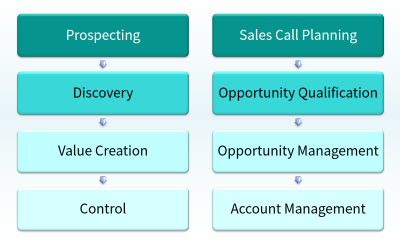
A sales process facilitated enquiry is a structured way of examining sales process steps, sales stages, governance, measurement, and maintenance from the set of eight functional perspectives illustrated.
Your sales staff compare current practice with commonly established ‘best practice’, revealing improvement opportunities.
It leads to the preparation of detailed change management plans for sales process improvement, governance clarification, measurement automation, and method maintenance for selected enquiry perspectives.
Cut the cost of selling, improve business predictability, and increase sales performance through a process of managed change.
The Sales Process Improvement Method
- To begin, establish best practices for each element of your sales process.
- Have your team score current sales practices compared with the best practices for each element.
- Review the scoring and seek agreement on the best practice gaps.
- Prioritise the urgency. What improvements will have the greatest impact on results?
- Seek a volunteer or appoint a project leader for each project.
- Have each project leader submit a plan for achieving the intended improvements.
- Set up periodic project reviews - weekly, biweekly, monthly - as appropriate for each project.
When we facilitate this process, we use an assessment that presents descriptions of example practices, ordered from the least structured to what is commonly held best practice for each of the eight sales process elements in the diagram above.
All involved senior executives, managers, and sales and marketing staff are invited to complete the assessment. It takes each person about twenty minutes.
Then we hold a workshop to review the results and seek agreement on current practices for each of the eight elements. There is usually much contention. The workshop needs a facilitator to help reach a consensus on current practices and the gaps.
Next, the participants are invited to prioritise the potential improvements across the eight elements of a sales process.
Finally, we invite improvement project champions to step forward and volunteer to lead adopted improvement projects.
The workshop is reconvened two weeks later for the project leaders to present their improvement plans.
Then we schedule review meetings with each project leader and their team to monitor progress until each improvement project is judged complete.
The method is completed in seven steps. The first six can be conducted consecutively or spread over a few weeks. Workshops can be online or face-to-face.
You can use this process to initiate improvement projects yourself. While it entails a lot of work, it is transformational, and management doesn't have to do all of the work. There are many direct and indirect benefits.
Arrange a call to learn more:
The Benefits
- Sales staff motivation
- Leadership development
- Improved governance
- Improved sales process
- Broader understanding of best practices
- Increased sales predictability
- Higher win rates
- Increased revenue and profits
Implementation transforms morale, motivations, and sales performance. Depending on the starting position, percentage improvements can be in double digits.
What does a sales process facilitated enquiry do?
- Identifies actionable improvement opportunities
- Prioritises the most important opportunities
- Encourages salespeople to become project champions
- Leads to sales process change management plans
- Gives the plans momentum
Who should participate?
For any transformation to take place, all the people who will have to make changes or who will be affected by changes must be represented in the change management process, including:
- All those who normally participate in sales policy decisions
- Those responsible for the management or supervision of salespeople
- One or more influential members of the affected sales teams
- Managers of groups who support sales, process orders, or deliver solutions
- Anyone else who is likely to be concerned about changes in the way salespeople work
Stages in the Facilitated Enquiry Process
The facilitated enquiry follows a structured sequence designed to move from assessment to agreed priorities and implemented improvements.
- Initial Briefing: The process begins with a short briefing session to explain the approach, set expectations, and answer questions. This ensures that everyone understands the purpose of the enquiry and how it will be conducted.
- Assessment: Each participant completes a short assessment to evaluate current sales process practices against commonly accepted best practices. This typically takes 10 to 20 minutes and provides a structured view of how the organisation currently operates.
- Positioning Review: The group meets to review the assessment results and agree on a consensus position for each of the eight functional perspectives. This stage often exposes differences in perception and prompts a detailed examination of current governance, behaviours, and effectiveness. Strong facilitation is important to ensure clarity and objectivity.
- Priority Review: The group agrees on which improvements should be prioritised and assigns ownership for each initiative. This may be combined with the positioning review where appropriate.
- Plan Creation: Assigned project leaders develop practical action plans for their respective improvements, working with those directly affected by the proposed changes. Plans are then presented to the wider group for challenge, input, and refinement. Effective facilitation ensures that plans are realistic, aligned, and properly thought through.
- Project Launch: Each improvement initiative is formally committed, with clear ownership and agreed actions.
- Project Reviews: Follow-up review meetings track progress, address issues, and maintain momentum. Project leaders report on progress and surface any obstacles requiring resolution. Reviews continue until each initiative is completed and embedded.
This process is straightforward in principle, but requires time, structure, and disciplined facilitation to apply effectively. Without this, discussions can drift, assumptions go unchallenged, and improvement initiatives lose momentum.
If you want to ensure that this process leads to clear decisions, practical plans, and real change, we can facilitate the enquiry with you.
Arrange a short call with Clive MIller to discuss how this could be applied in your organisation:
Facilitated Enquiry Duration
- The initial briefing usually takes between 30 and 60 minutes.
- It is normal to allow a week for everyone to complete the assessment.
- Depending on the number of people involved and the number of projects initiated, 8 to 10 hours of meeting time should be set aside to complete stages 3 through 6. Project leaders may need to convene additional side meetings.
- Project reviews can usually be completed within an hour for each project. Reviews should continue periodically until each improvement project is completed.
Results Measurement
The selection of key performance indicators, the collection of benchmark data, and the identification of monitoring and reporting methods are usually detailed in each project plan. Results are discussed in project reviews, as soon as comparison with benchmark data becomes appropriate.
Frequently Asked Questions About Sales Process Improvement
Can we run this process ourselves?
Yes. The process is designed to be management-led and can be run internally. However, it requires time, structure, and disciplined facilitation to keep discussions objective, challenge assumptions, and reach clear decisions.
Why involve the sales team instead of defining the process centrally?
Salespeople are closest to real opportunities and understand what works in practice. Involving them leads to more practical decisions and makes adoption far more likely. Processes imposed without involvement are often ignored or applied inconsistently.
What is the role of facilitation in this process?
Facilitation helps the process stay focused, structured, and productive. It ensures that important questions are worked through properly, that difficult issues are addressed, and that the group reaches usable conclusions rather than just having a discussion.
How long does the facilitated enquiry process take?
The initial stages can be completed quite quickly, but the overall timescale depends on the number and scope of the improvements identified. Follow-up reviews usually continue until the agreed initiatives are implemented and judged complete.
What outcomes should we expect?
The process produces a more clearly defined and agreed sales process, prioritised improvement initiatives, and practical action plans. It also improves alignment, consistency, and confidence in how sales opportunities should be handled.
How is this different from sales training?
Sales training usually focuses on developing individual skills, knowledge, or techniques. This process focuses on defining how the organisation should sell, aligning the team around that process, and improving consistency and effectiveness across the business.
Have us lead a sales process facilitated enquiry for you.
Arrange a call with Clive MIller to learn more:
If you need to increase sales performance, use this change management facilitated enquiry approach to initiate sales process improvement. For assistance, telephone +44 (0)1392 851500. Alternatively, use the contact form here or send an email to jimm@salessense.co.uk for more information.