How sales managers can improve forecast accuracy, increase win rates, and reduce wasted selling effort.
Most sales forecasts are wrong for the same reason.
Sales opportunities enter the pipeline long before anyone has established whether they deserve to be there.
Salespeople are naturally optimistic. Sales managers are often under pressure to maintain pipeline volume. The result is predictable. Forecasts become inflated, resources are misallocated, and valuable selling time is invested in opportunities that never had much chance of closing.
Improving qualification is one of the fastest ways to improve forecast accuracy, increase win rates, and reduce wasted effort. Yet many organisations still treat qualification as a single event rather than a progressive process.
The strongest sales organisations qualify opportunities on several levels.
Each level adds evidence. Each level reduces uncertainty.
Let's explore four increasingly sophisticated levels of qualification.
Level 1: Pre-Qualification
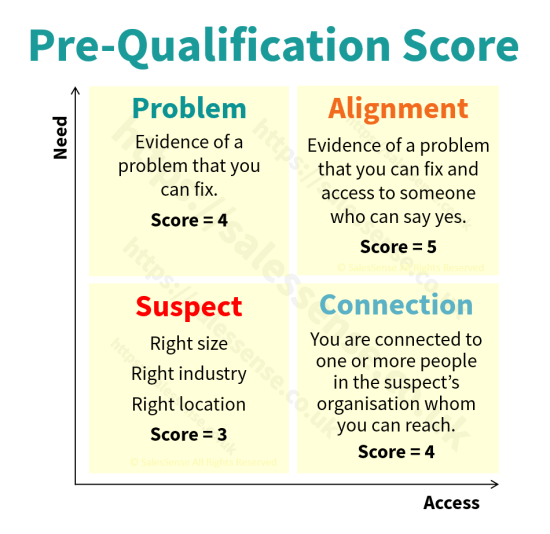
Before a salesperson invests serious effort, there should be some indication that an opportunity deserves attention.
This is the purpose of pre-qualification.
The objective is not to determine whether a sale will definitely happen. It is simply to decide whether the prospect is worthy of further investigation.
Questions might include:
- Does the organisation fit our target customer profile?
- Do they appear to have a potential need?
- Are they of sufficient size or value?
- Are they operating within a market we serve?
- Is there evidence of change, growth, dissatisfaction, or another trigger event?
Many organisations fail at this first hurdle.
Salespeople pursue every enquiry, every referral, and every conversation as though it deserves equal attention. It doesn't.
The earliest qualification decisions should focus on intelligent suspect selection. The better the quality of prospects entering the pipeline, the less effort is wasted later.
This principle has existed for decades, although modern terminology such as Account-Based Marketing (ABM) and Account-Based Engagement (ABE) has given it a new label. The underlying idea remains unchanged. Start with organisations that are most likely to buy.
Pre-qualification answers one simple question:
Is this prospect worth investigating further?
If the answer is no, move on.
Level 2: Quantified Qualification
Traditional qualification frameworks often produce subjective conclusions.
One salesperson believes an opportunity is highly qualified. Another reaches a completely different conclusion.
The problem is inconsistency.
Quantified qualification introduces a structured scoring approach.
Rather than asking whether qualification criteria have been met, we ask:
How strongly have they been met?
For example:
- Business need
- Financial justification
- Access to decision makers
- Competitive position
- Timescale
- Consequences of inaction
- Stakeholder support
- Implementation capability
Each factor can be scored.
The combined result produces a qualification score that is far more useful than a simple yes-or-no assessment.
This is the thinking behind the SalesSense Sales Win Predictor. Rather than relying solely on opinion, multiple factors are assessed and combined to estimate the likelihood of success. The objective is not perfect prediction. The objective is better decisions.
Quantified qualification also creates coaching opportunities.
Managers can challenge assumptions.
A salesperson who claims an opportunity is "90% certain" can be asked to explain why the qualification score suggests otherwise.
The conversation becomes evidence-based rather than emotional.
At this level, qualification answers a more sophisticated question:
How likely are we to win, based on what we currently know?
Level 3: Historical Close Rates by Sales Stage
Most CRM systems assign probabilities to sales stages.
Unfortunately, many of these percentages are arbitrary.
Proposal submitted might be assigned 70%.
Demonstration completed might be assigned 50%.
Negotiation might be assigned 80%.
The numbers often reflect wishful thinking rather than reality.
A more intelligent approach is to analyse historic close rates.
Look back over the last twelve to twenty-four months.
Determine:
- How many opportunities reached each stage.
- How many ultimately closed successfully.
- How many were lost.
- How many simply disappeared.
You may discover surprising results.
For example:
- Opportunities reaching discovery may close at 12%.
- Opportunities reaching proposal may close at 28%.
- Opportunities reaching negotiation may close at 45%.
These real-world percentages are usually far lower than the figures assigned in CRM systems.
That is precisely why they are valuable.
Historic stage conversion rates introduce objective evidence into forecasting.
They provide a reality check.
They also help identify weaknesses within the sales process. If opportunities consistently stall between qualification and proposal, the issue becomes visible.
Many sales managers focus exclusively on individual opportunities. Historic close-rate analysis allows them to improve the entire sales system.
At this level, qualification answers the question:
What normally happens to opportunities that look like this?
Level 4: Salesperson Judgement
At this point, some managers become uncomfortable.
If we have quantified qualification and historical close rates, why do we need judgement?
Because sales is still a human activity.
Experienced salespeople often detect subtle indicators that no scoring system captures.
They hear uncertainty in a prospect's voice.
They notice political tensions between stakeholders.
They sense enthusiasm, urgency, hesitation, or hidden resistance.
These signals are difficult to quantify but often influence outcomes.
The mistake many organisations make is allowing judgement to replace evidence.
The opposite mistake is eliminating judgement altogether.
The strongest approach combines both.
Use quantified qualification.
Use historic close-rate analysis.
Then ask the salesperson:
On a scale of one to ten, what does your experience tell you about this opportunity?
This judgement score should never override the evidence.
It should sit alongside it.
When qualification scores, historic probabilities, and salesperson judgement all point in the same direction, confidence increases.
When they disagree, managers gain a valuable coaching opportunity.
A salesperson who consistently rates weak opportunities highly may need support in developing qualification skills.
Equally, a salesperson whose judgement repeatedly identifies hidden risks may possess valuable experience that deserves attention.
Bringing the Four Levels Together
Most organisations stop at Level One.
Better organisations reach Level Two.
Few consistently apply Levels Three and Four.
Yet the combination is powerful.
Effective qualification becomes a progression:
- Pre-Qualification — Is this worth pursuing?
- Quantified Qualification — How likely are we to win?
- Historic Stage Performance — What usually happens to opportunities like this?
- Salesperson Judgement — What does experience suggest?
Each level reduces uncertainty.
Each level improves forecasting.
Each level helps sales managers coach more effectively.
Most importantly, each level helps salespeople invest their time where it is most likely to produce results.
Because qualification is not really about deciding whether to pursue an opportunity.
It is about deciding where to focus finite selling resources to achieve the greatest return.
And in competitive B2B sales environments, that may be the most important decision a salesperson ever makes.
Article by Clive Miller
Clive Miller is a UK-based sales consultant, trainer, and coach with over 30 years’ experience helping B2B organisations improve sales performance and decision-making effectiveness.
Schedule an informal conversation.
If you need to improve sales qualification, we can help. Telephone +44 (0)1392 851500. We will be pleased to learn about your needs or discuss some options. Alternatively, email jimm@salessense.co.uk or use the contact form here.