How to Diagnose Sales Performance Problems
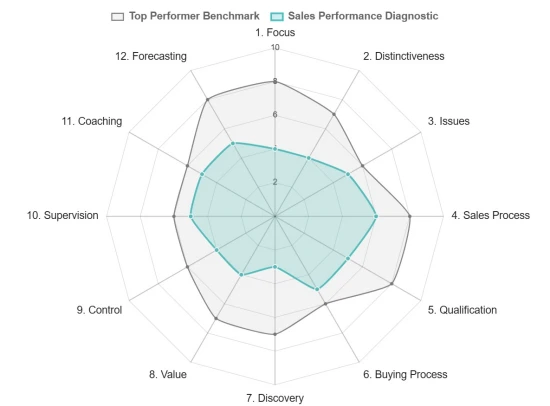
Sales results rarely improve simply by working harder. Constraints within the sales system are the more likely cause. Guessing wastes time. Use this sales performance diagnostic to find out.
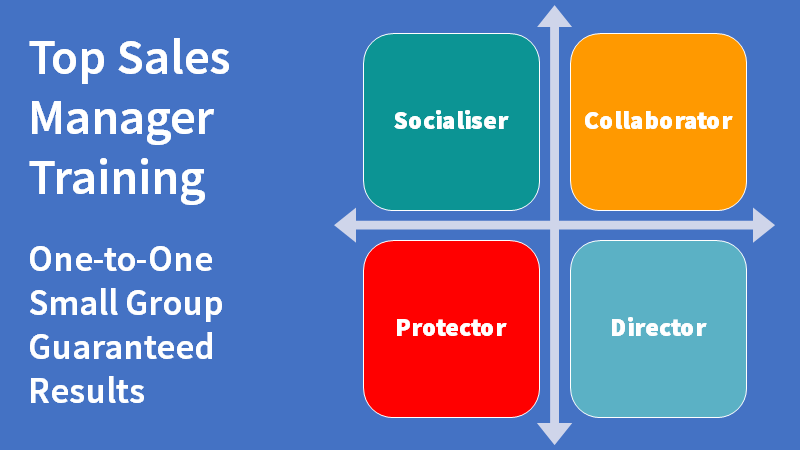
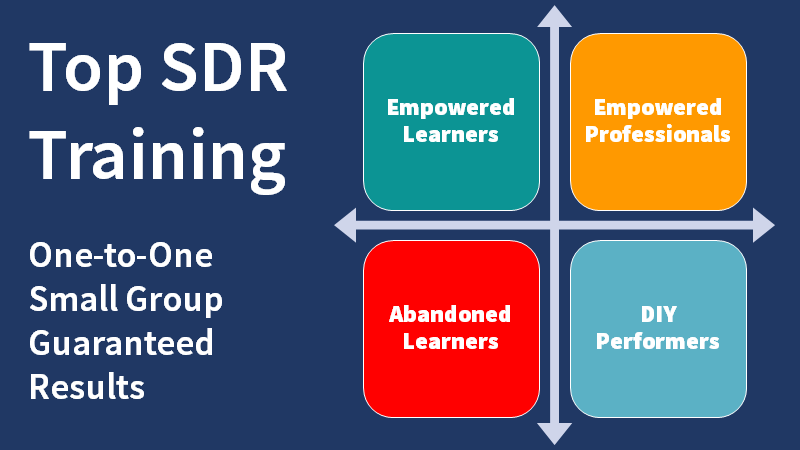
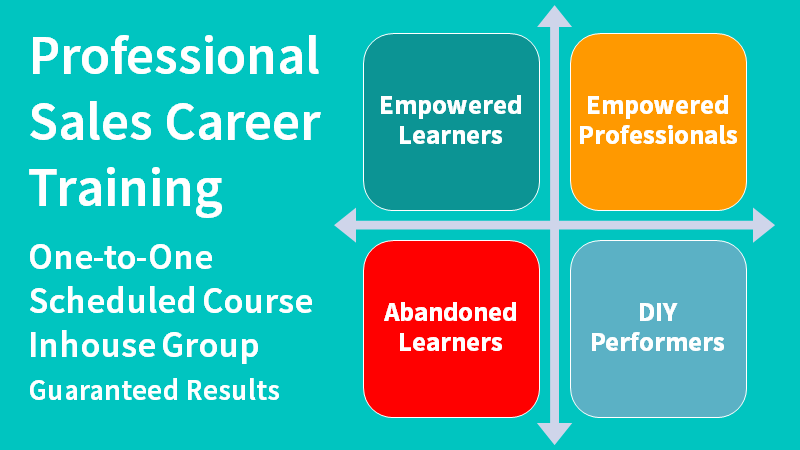
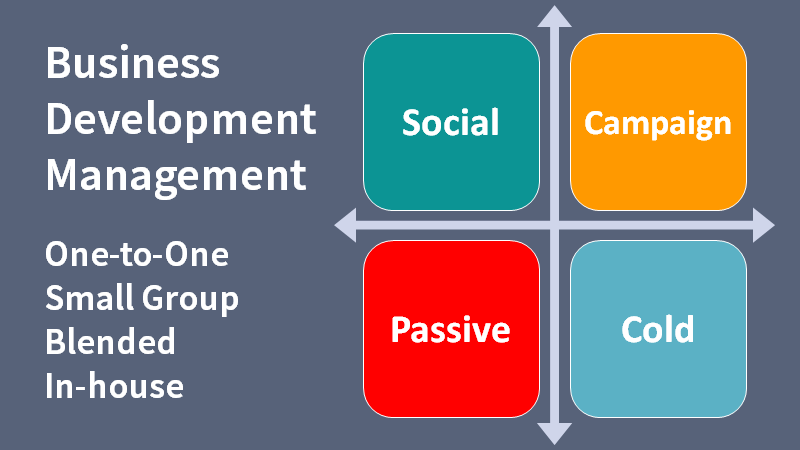
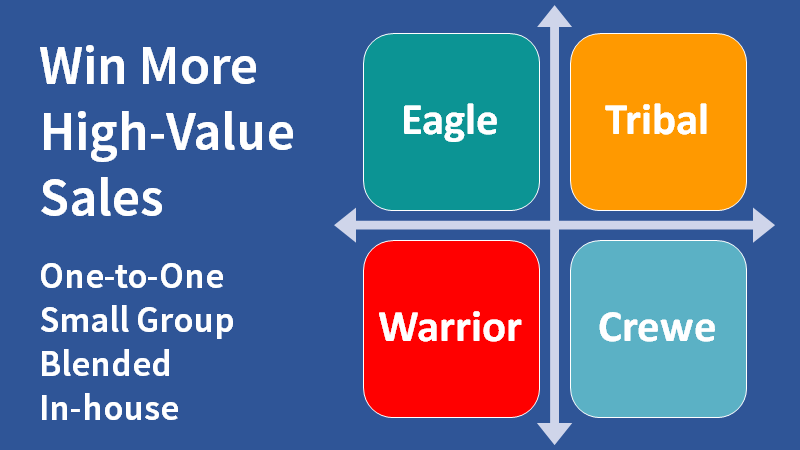
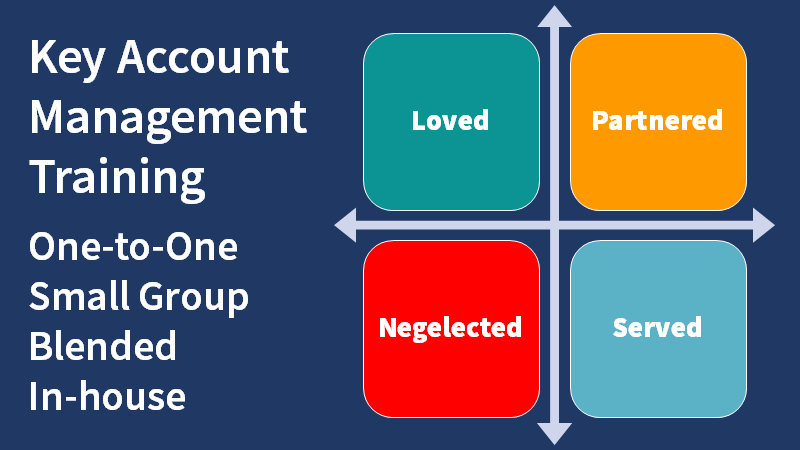
This free 12-part diagnostic helps identify the real constraint on sales performance by examining the four areas that most often determine results:
In a few minutes, you will see where improvement is most likely to increase results.
Used by sales leaders to:
- Identify training needs
- Guide coaching discussions
- Benchmark team capability
- Improve sales performance
Sales Performance Diagnostic Completion Instructions:
Score your organisation or team on twelve statements, according to the truth of each statement.
Enter a score between 1 and 10 in the adjacent boxes. A high score indicates complete agreement with the statement.
Use the guide associated with each statement. Make the score reflect reality.
Your total score and a chart showing your strengths and weaknesses will be updated in real time at the bottom of the page.
Customer Focus: 1. How clearly is your target customer defined? We have a written ideal customer profile (ICP) that includes industry verticals, markets addressed, organisation size, accessibility, cultural alignment, and the typical issues that we can help address. Guide: This is completely true or almost completely true. Score 8 to 10: | |
Perceived Distinctiveness: 2. How is your offering differentiated in the market? What we offer is unique. No other vendor in the market offers anything comparable. Our differentiation is documented and published internally. Our salespeople can explain our differentiation using facts. Their ability to answer the question, "How is what you sell different?" is verified through appraisals, listening to call recordings, or joint visits at least twice a year. Guide: This is completely true or almost completely true. Score 8 to 10: | |
Customer Issues: 3. How well do salespeople understand the problems you address? The problems and opportunities that our offerings address are documented and published internally. Our salespeople are required to be familiar with the documented issues and fluent in discussing them with customers. We verify their ability through appraisals, call recordings, or joint visits at least twice a year. Guide: This is completely true or almost completely true. Score 8 to 10: | |
Sales Process: 4. How consistently do salespeople follow a defined and optimised sales process? We have a documented sales process that is aligned with the stages in a typical customer buying process. In addition, the stages are mirrored in our CRM. Salespeople are expected to follow the sales process. Compliance is monitored and reported. Guide: This is completely true or almost completely true. Score 8 to 10: | |
Qualification: 5. How well are opportunities qualified before they are listed as opportunities? We use a prequalification scoring system aligned with our ICP and a mandatory quantified qualification tool for leads that become opportunities. We track historical sales stage conversion rates and use this data to inform on win probabilities. Guide: This is completely true or almost completely true. Score 8 to 10: | |
Buying Process: 6. How well do salespeople understand the customer's buying process? We have documented the stages of a typical customer's buying process and published it internally. We use it to guide deal and forecast reviews as well as the stages in our sales process. As a consequence, our salespeople are very familiar with the way our customers buy. Guide: This is completely true or almost completely true. Score 8 to 10: | |
Discovery: 7. Do your salespeople uncover enough information in initial conversations? We have a documented discovery process that lists the objectives of a discovery conversation and suggests appropriate questions for uncovering the desired information. Our salespeople are expected to use the discovery process. It is used to guide deal reviews as a means of reinforcement. Guide: This is completely true or almost completely true. Score 8 to 10: | |
Customer Conversations: 8. How effectively do salespeople communicate value? We document and substantiate the business outcomes of using what we sell through example business plans, testimonials, case studies, and stories. Our salespeople are expected to know the use cases and substantiation for each application. Their use case and story knowledge is evaluated at least twice a year. Guide: This is completely true or almost completely true. Score 8 to 10: | |
Control: 9. How do salespeople manage complex buying groups? We use an opportunity management plan that prompts identification and engagement with all important buying interests in a complex sale. Our salespeople are required to use the opportunity plan for all sales that meet the associated criteria. The resulting opportunity plan is used in deal reviews. Guide: This is completely true or almost completely true. Score 8 to 10: | |
Sales Management: 10. How effective are sales managers at reviewing opportunities? We have a documented multistage process for deal reviews that sales managers use and report on. Guide: This is completely true. Score 8 to 10: | |
Coaching: 11. How often are salespeople offered coaching? Our sales managers are trained in coaching skills and are expected to offer coaching in one-to-one and deal review meetings with each of their team members. Guide: This is completely true. Score 8 to 10: | |
Forecasting: 12. How reliable are sales forecasts? Our sales forecasts are based on sales stage qualification criteria, a quantified opportunity qualification tool, historical conversion rates, and the opinions of the salespeople involved. Our sales forecasts are usually within + or - 10% of the actual results and almost always within + or - 20%. Guide: This is completely true. Score 8 to 10: | |
| Total Sales Performance Diagnostic Score |
Sales Performance Diagnostic Assessment Score Guide
The grey area on the chart represents scores of high-performance sales teams and individuals. Whatever your scores, the chart reflects strengths and weaknesses. Strengths present opportunities for further improvement. Low scores indicate vulnerabilities that can be addressed through management or individual initiatives.
Don't leave it here. Decide on your next action and schedule the time. Action is the key to all progress.
Here are some suggestions:
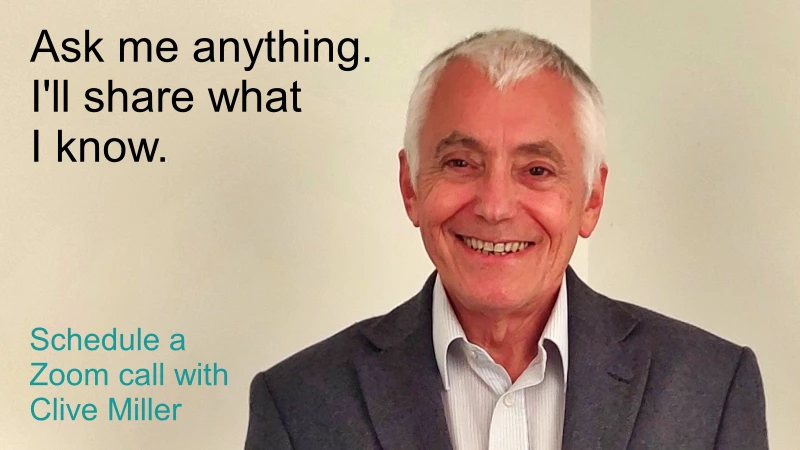
Schedule a call with Clive Miller, the assessment author, to discuss your results.
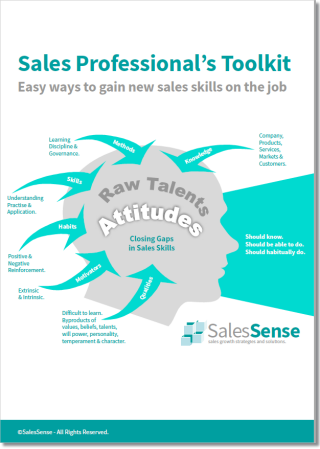
Clive Miller is a UK-based sales consultant, trainer, and coach with over 30 years’ experience helping B2B organisations improve sales performance and decision-making effectiveness. He is the author of more than twenty sales and management training courses, and three books: The Sales Professionals Toolkit, the Sales Success Formula, and The Power to Speak in Public.
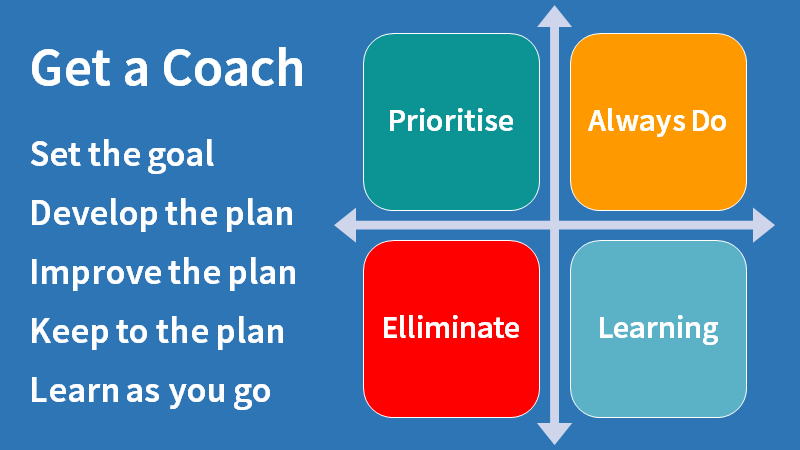
- Set up a regular leadership coaching session. Managers with a coach have higher-performing teams.
- Decide what you want to improve and make a plan. How to Get Better at Anything
- Explore our management and leadership articles.
If you are looking for individual or bespoke sales performance diagnostic assessments, we can help. Telephone +44 (0)1392 851500, send an email to jimm@salessense.co.uk or use the contact form here.
Email These Results
Enter your details to receive a report with your assessment results, expanded analysis, suggested actions, and Clive Miller's Sales Success Formula. Note: The email is sent from wm@salessense.co.uk. If the email does not arrive, check your SPAM folder.