Why the Best Sales Managers Combine Artificial Intelligence with Human Development
One-to-one sales coaching works. Our research revealed an average 13% improvement. Now, AI boosts the results further. In this article, I explain how AI improves sales coaching and what you can do to take advantage.
AI improves sales coaching by analysing sales conversations, customer interactions, and deal progress to identify the behaviours that lead to successful outcomes. Sales managers can use these insights to provide more targeted coaching, helping salespeople improve discovery, stakeholder engagement, and decision guidance.

Artificial intelligence is rapidly transforming sales. AI now researches prospects, drafts emails, analyses sales calls, scores leads, forecasts revenue, and automates many of the administrative tasks that once filled a salesperson’s day.
Yet one of the most interesting developments is happening somewhere less obvious.
Artificial intelligence is changing how salespeople are coached.
For years, organisations have known that coaching is one of the most powerful drivers of sales performance. Studies consistently show that regular coaching improves win rates, increases quota attainment, and accelerates the development of new salespeople.
The problem has never been whether coaching works, but how to do it consistently and effectively. Artificial intelligence is beginning to solve that problem.
The Traditional Challenge of Sales Coaching
In many organisations, sales coaching has historically been inconsistent. Managers are busy. Sales teams are under pressure. Deals demand attention. As a result, time for coaching is squeezed and often continually postponed. At best, most coaching is occasional, reactive, based on memory or opinion, and focused only on struggling salespeople.
Managers might listen to a few calls, review a handful of deals, or give feedback after a lost opportunity. But it is difficult to analyse patterns across hundreds of sales conversations. In practice, this means coaching is often subjective rather than objective. It is impression-based rather than evidence-based.
Artificial intelligence changes that.
How AI Changes the Coaching Process
AI systems can analyse enormous volumes of sales activity. Conversation intelligence platforms, for example, can automatically review recorded sales calls, video meetings, email conversations, CRM activity, and deal progress patterns.
Instead of relying on occasional observations, managers can see consistent behavioural patterns across entire sales teams. This allows coaching to become far more precise.
AI can highlight:
- which discovery questions generate deeper conversations
- where deals typically stall
- how top performers structure conversations
- which behaviours correlate with higher win rates
The result is not automated coaching. Salespeople and their coach or manager now base interactions on objective information.
From Guesswork to Evidence-Based Coaching
One of the most powerful effects of AI is that it removes much of the guesswork from coaching.
Traditionally, a manager might say:
“You need to ask better discovery questions.”
With AI insights, the feedback becomes far more specific, for example:
- top performers ask twice as many diagnostic questions
- winning calls include more discussion of business impact
- deals stall when insufficient value is associated with the buying vision
This makes coaching far more practical and actionable. Instead of abstract advice, the coach can provide behaviour-level guidance guided by non-judgmental facts.
Identifying What Top Performers Do Differently
Another benefit of AI is the ability to analyse what successful salespeople actually do.
In many teams, top performers succeed for reasons that are not immediately obvious. Their behaviours are difficult to articulate, and their methods are rarely documented. AI can identify patterns across hundreds or thousands of interactions.
For example, it may reveal that successful sellers:
- speak less and ask more questions
- involve multiple stakeholders earlier
- frame conversations around business outcomes rather than product features
Once these patterns are visible, managers can deliver or direct coaching based on known best practice, encouraging other team members to adopt the same behaviours. This transforms coaching from subjective, judgmental advice into practical skill development.
Detecting Coaching Opportunities Earlier
AI also helps managers detect problems earlier in the sales process. Instead of discovering issues only after deals are lost, AI systems can identify early warning signals such as declining buyer engagement, stalled deal progression, weak discovery conversations, and insufficient stakeholder involvement.
Managers can then intervene earlier, helping the salesperson adjust their approach before the opportunity is lost.
This moves coaching from post-mortem analysis to proactive guidance.
Personalised Coaching for Every Salesperson
Traditional coaching often focuses on the lowest performers. AI makes it easier to coach everyone. Because the system continuously analyses performance data, managers can see the specific development areas for each salesperson.
One team member may need help with discovery conversations. Another may struggle with negotiation. Another may need to improve stakeholder management. Coaching becomes individualised rather than generic.
Why Human Coaching Still Matters
Despite the power of AI analysis, coaching remains fundamentally human. Artificial intelligence can highlight patterns, but it cannot replace the human elements of development, such as judgement, encouragement, experience, empathy, and leadership.
Salespeople rarely improve simply because data tells them what to do. They improve when a manager or coach helps them understand the impact of a change, how to apply it in real conversations, and how to develop confidence in new approaches.
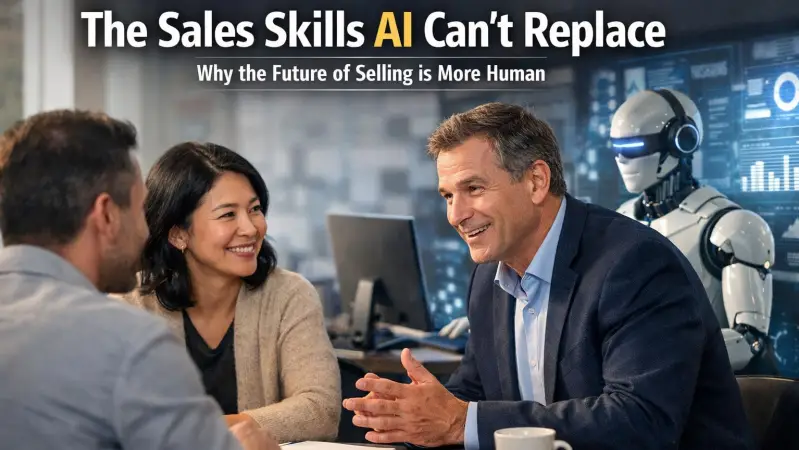
This is why the future of sales coaching is not AI replacing a coach or manager. It is AI supporting better coaching.
The Emergence of AI-Assisted Sales Leadership
The organisations seeing the greatest benefit from AI are those that treat it as a coaching support tool, not an automated replacement for leadership.
In these environments:
AI analyses behaviour.
Managers interpret the insight.
Salespeople develop new skills.
This creates a powerful combination of data-driven insight, human judgement, and practical skill development. It is exactly the kind of partnership between humans and technology described in our related article, The AI-Augmented Salesperson.
Coaching in the Age of AI
Artificial intelligence will continue to change how selling works. Many routine sales activities are already being automated, yet the development of human capability will remain essential.
In fact, as explored in our cornerstone article Will AI Replace Salespeople, the competitive advantage in sales is shifting toward the skills that technology cannot replicate. Consequently, sales coaching becomes even more important.
The difference is that managers now have better tools to support it.
FAQ: How AI Improves Sales Coaching
How can artificial intelligence improve sales coaching?
Artificial intelligence improves sales coaching by analysing large volumes of sales interactions such as calls, emails, and meetings. AI tools can identify patterns in successful sales conversations, highlight missed opportunities, and reveal behaviours that lead to better results. This allows sales managers to provide more specific and data-driven coaching to their teams.
Can AI replace human sales coaching?
No. AI can analyse data and identify patterns, but it cannot replace the judgement, experience, and leadership that effective sales coaching requires. The most successful organisations use AI to support sales managers by providing insights that help them coach more effectively.
What AI tools are used for sales coaching?
AI-enabled sales coaching tools typically include conversation intelligence platforms, CRM analytics, call analysis software, and revenue intelligence systems. These tools analyse sales calls, identify key moments in conversations, and highlight behaviours associated with successful deals.
How does AI analyse sales conversations?
AI systems use speech recognition and natural language processing to analyse recorded sales calls and meetings. They can identify keywords, talk-to-listen ratios, customer questions, and patterns in how conversations develop. This helps managers understand how top performers communicate with buyers.
Why is sales coaching becoming more important in the age of AI?
As artificial intelligence automates routine sales tasks, the competitive advantage increasingly shifts toward human skills such as judgement, trust building, and complex decision support. Sales coaching helps develop these skills, making it even more valuable in an AI-enabled sales environment.
How should sales managers use AI for coaching?
Sales managers should use AI as a diagnostic tool rather than a replacement for coaching. AI can identify patterns in sales behaviour and highlight areas for improvement, but managers must interpret these insights and help salespeople apply them in real customer conversations.
Conclusion
Artificial intelligence is not eliminating sales coaching; it is making it more effective.
By analysing patterns across sales activity, identifying behavioural differences between high and low performers, and highlighting early warning signals in deals, AI gives managers the insight needed to coach more precisely. Human sales managers remain essential.
AI can provide information. Only a human leader can turn that information into growth, confidence, and improved performance. The organisations that thrive in the AI era will be those that combine artificial intelligence with better coaching.
Article by Clive Miller. Arrange a conversation or call +44 1392 851500.
Clive Miller is a UK-based sales consultant, trainer, and coach with over 30 years’ experience helping B2B organisations improve sales performance and decision-making effectiveness.
Related Resources:
- Changing Behaviour
- Sales Performance Improvement
- Sales Coaching for Decision Partner Capability
- Selling with Integrity
- The Perfect Discovery Sales Call
Do you need to increase sales? How AI improves sales coaching can deliver incremental results. If you need to set up or expand a coaching programme, we can help. Schedule a consultation or call +44 (0)1392 851500. Alternatively, use the contact form here or send an email to jimm@salessense.co.uk.