Start with your best customers to build an accurate ICP.
Most organisations already know who their ideal customers are. They just haven't noticed. Ask a sales team to describe their Ideal Customer Profile (ICP) and you'll often hear something like this:
"Manufacturing companies with between 100 and 500 employees."
"Medium-sized professional services firms."
"Construction companies throughout the UK."
That isn't an Ideal Customer Profile. It's a market description. It tells you who they are, but nothing about whether they are likely to buy.
If you have bread to sell, don't look for people who own kitchens. Look for people who are hungry.
The same principle applies in business. The easiest sales are usually made to organisations with a compelling reason to change. The challenge is discovering what that reason looks like before you pick up the telephone or write an email.
Stop Inventing Your Ideal Customer Profile
Many companies build an ICP by sitting in a meeting room and debating what their ideal customer might look like.
There is a much better approach.
Start with your best customers. Not your biggest customers. Not your favourite customers. Not the ones who negotiated the hardest. The customers who genuinely receive the greatest value from what you sell and who, in return, provide the greatest value to your business.
Those customers have already solved the puzzle for you. Your task is simply to work backwards and discover why they bought. Perhaps you already know.
Look for Patterns
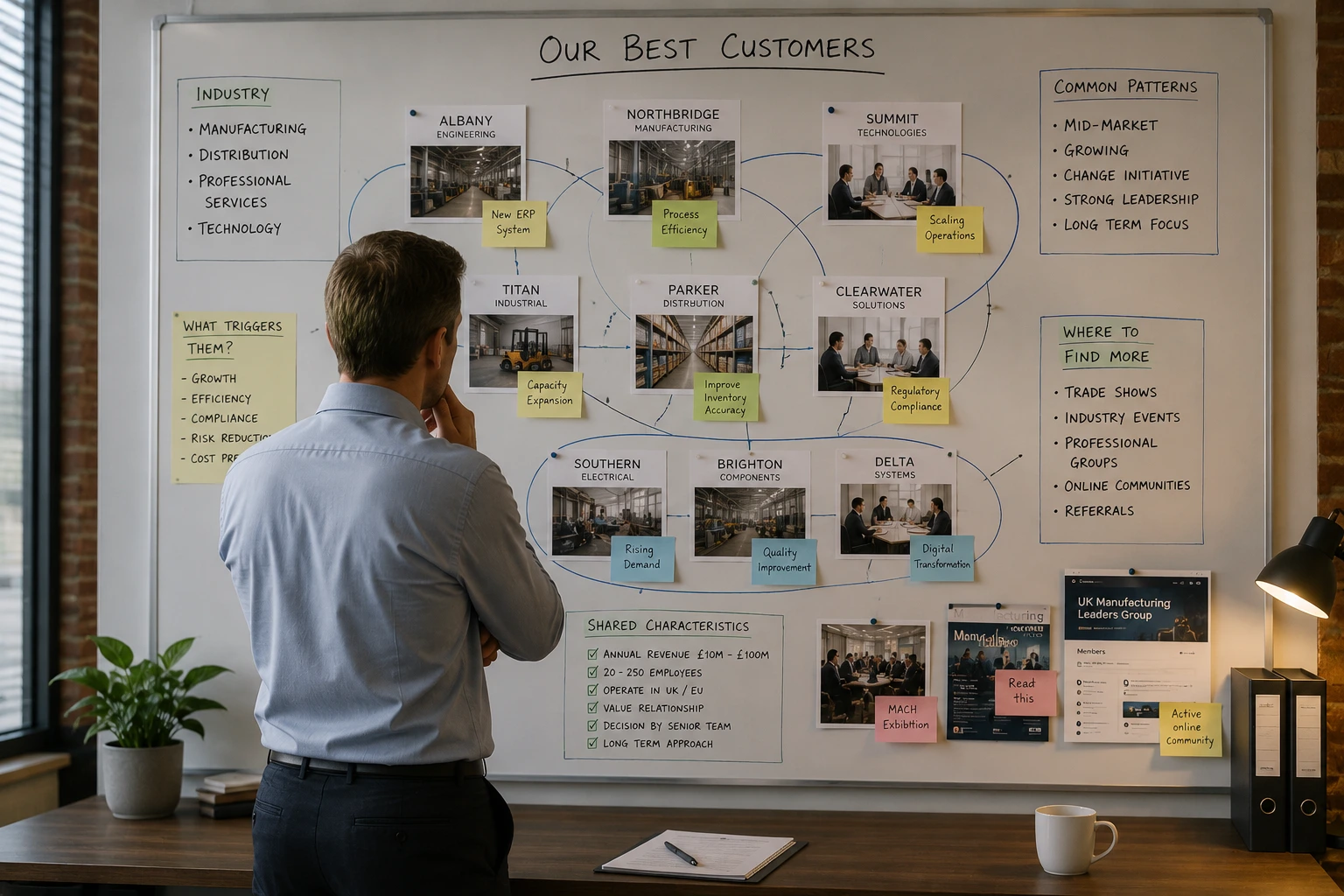
One customer proves very little. Five or ten good customers often reveal remarkably consistent patterns. That is why our Ideal Customer Profile template starts by profiling existing customers rather than imaginary prospects.
Begin with questions like these.
- What problem or opportunity prompted them to buy?
- What was happening in their business immediately beforehand?
- What were they trying to achieve?
- What industry are they in?
- How large are they?
- What products or services do they provide?
- Who are their customers?
- What trends were affecting their business?
- Were they growing?
- Were they under pressure?
- Were they expanding?
- Were they responding to legislation?
- Were they replacing ageing equipment?
- Were they recruiting?
- Were they entering new markets?
The more customers you analyse, the easier it becomes to recognise recurring themes. Those recurring themes must be captured in your ICP.
The Trigger Matters More Than the Company Size
This is where many organisations make a mistake. They concentrate on firmographics.
Industry.
Revenue.
Number of employees.
Geography.
Those characteristics help narrow a search, but they rarely explain why somebody buys.
The trigger is usually far more important.
A manufacturing company who are replacing an ageing production system.
A university expanding online learning.
A software company who are preparing for rapid growth.
A business that is facing a regulatory audit.
A distributor who is struggling with stock accuracy.
Each describes a circumstance rather than a category.
That circumstance is what creates demand.
If you understand the circumstances that create demand for what you sell, your prospecting becomes dramatically easier because you stop approaching everyone and start approaching those who have a reason to listen.
Build the Whole Picture
A useful ICP extends well beyond company size and sector.
Our template deliberately explores areas that many businesses overlook.
For example:
What conferences do they attend?
Which trade journals do they read?
Where do they advertise?
What professional groups do they belong to?
What trends have affected revenue during the last five years?
What strengths distinguish them?
What threats concern them?
All of this information makes prospecting easier. It tells you where similar organisations can be found. It suggests what they are likely to be thinking about. It helps you write messages that sound immediately relevant.
Profile the Business, Not Just the Buyer
Modern selling often concentrates heavily on buyer personas. There is nothing wrong with understanding individual decision-makers. But before worrying about personalities, understand the business.
Businesses buy because of change. They have to keep up with market demand, remain competitive, drive down costs, and seize new opportunities. Those changes create buying opportunities.
Once you understand why the organisation needs to act, identifying the people who can authorise action becomes much easier.
Don't Ignore Businesses That Haven't Started Looking Yet
There are two kinds of ideal prospects.
Every salesperson is looking for businesses that know they have a problem and are actively searching for a solution. Timing is critical. If you are late, you have a battle to be included in their considerations.
Then there are those businesses that know they have the problem but don't yet realise that a practical solution exists.
The second group often represent the greatest opportunity because competition has not yet arrived, and you can be the first to introduce a new way to resolve their problem or make their opportunity accessible.
Use Your ICP to Improve Every Part of Prospecting
A good ICP is much more than a prospect list. It improves almost everything that follows. Salespeople waste less time. Marketing creates more relevant campaigns. Prospecting emails become more interesting. Cold calls become warmer.
Qualification becomes faster. Sales cycles are shorter. Win rates are higher.
One of the easiest ways to test an ICP is to compare it with your recent sales successes.
Would your profile have identified those customers before they bought?
If not, refine it.
An ICP should evolve continuously as markets, products and customer priorities change.
An Exercise Worth Doing
Choose your ten best customers and ask them why they bought! This is so simple. After the event, the question often reveals unexpected insights. Ask the account managers. Review any win reports. Ask the customers directly.
Look at what happened immediately before each organisation decided to buy.
Use what you learn in each case to complete an Ideal Customer Profile. Use our free template. Request a copy or complete the form below. Then lay the completed customer profiles side by side.
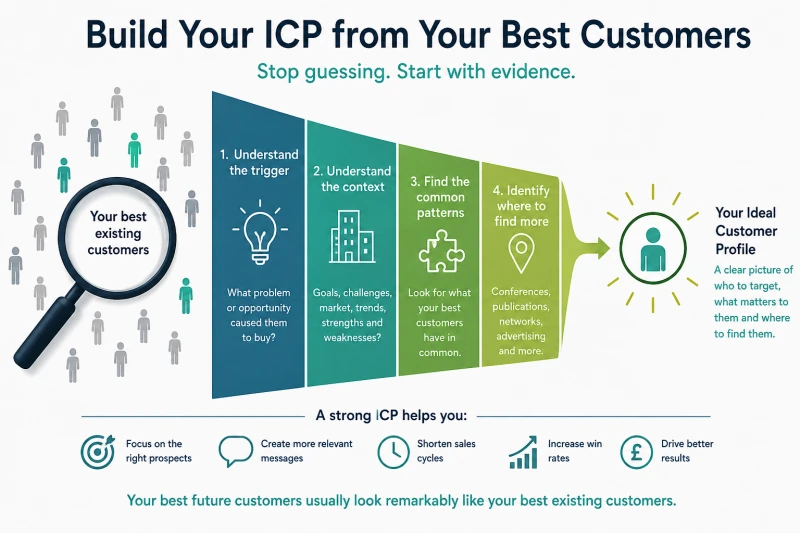
You'll probably discover that your best customers have much more in common than you expected. Those similarities become your blueprint for finding the next generation of customers.
Final Thought
Prospecting becomes difficult when you are trying to persuade people who have little interest in what you sell. It becomes much easier when you identify organisations that already have a compelling reason to change.
The objective of an Ideal Customer Profile is not simply to describe a market. It is to recognise the need before making contact.
If you have bread to sell, don't waste your time calling on people who have just finished lunch. Find the hungry ones. That's where the opportunities are.
Article by Clive Miller
Complete this form to get our free ideal customer profile template:
Ideal Customer Profile Template
Enter your details below. We will email you a link to verify your address and download the document.
Related Articles:
- Easy and Practical Sales Prospecting for a GDPR World
- 27 Secret Ways to Find More Sales Leads Without Cold Calling
- How to Find the Hottest Sales Prospects
- Reach and Engage with More Sales Prospects
- When You Hate Cold Calling but Need More Sales Opportunities
- Get Introductions via People You Don't Know
If you need to increase sales prospecting activity, raise the number of contact events achieved by salespeople, or improve cold email or cold outreach efficiency, get in touch. Telephone +44 (0)1392 851500. We will be pleased to learn about your needs or talk through some options. Alternatively, email to custserv@salessense.co.uk or use the contact form here.