The commercial return from the use of AI in sales begins when the saved time is used to improve selling.
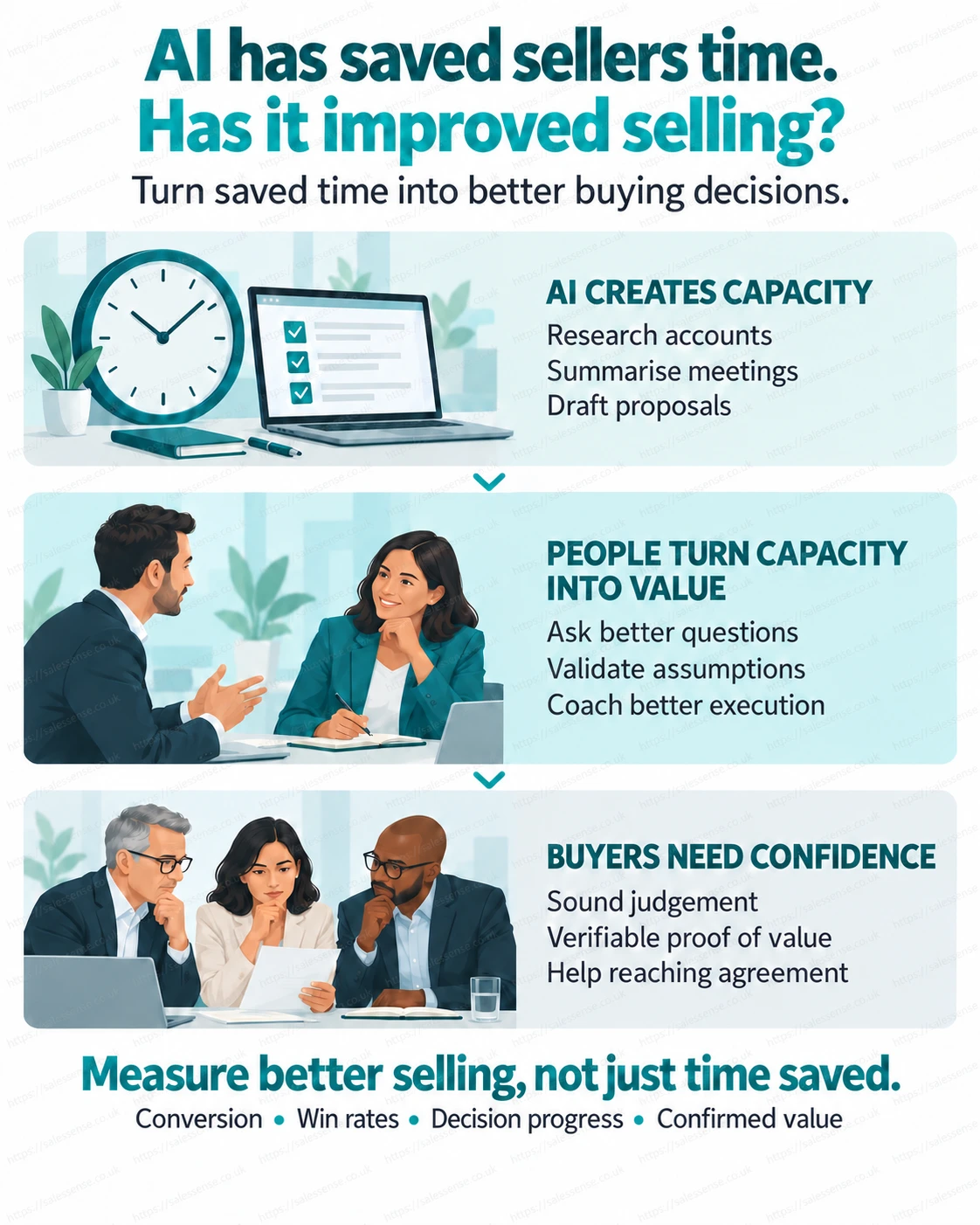
AI can research a prospect, summarise a meeting, draft a proposal and update a CRM record. These are useful capabilities. The use of AI in sales gives salespeople more time to spend with customers.
But what happens to the time saved?
Does it produce a better understanding of the customer’s situation? Stronger proof of value? More productive conversations? Does it help customers make decisions?
If we cannot answer these questions, we have measured efficiency without establishing whether selling has improved.
Three recent 2026 publications from BCG, Forrester and Seismic offer different perspectives on this problem. My reading is that technology has moved ahead of organisational execution. Meanwhile, buyers need help exercising judgement, evaluating evidence and reaching decisions they can defend.
Does use of AI in sales increase results?
BCG surveyed 398 sales and revenue leaders across 23 countries. Ninety per cent reported meaningful AI use in sales workflows, yet only 14% reported improved conversion and 13% reported better win rates. These are reported areas of impact, rather than proof of what AI causes. Nevertheless, they reveal a considerable gap between adoption and commercial results.
Saving time creates an opportunity. What a sales organisation does with that opportunity determines its value.
Consider preparation for a customer meeting. AI can assemble company information and suggest likely business challenges. A salesperson can use this material to develop questions and identify assumptions that need testing.
Alternatively, they can arrive with a polished presentation built around an unverified diagnosis.
Both approaches use AI. Only one starts by finding out whether the seller’s understanding is correct.
The same distinction applies to proposals. Producing one in twenty minutes instead of two hours is helpful. Its commercial value still depends on whether it addresses an agreed need, demonstrates a credible return and reflects how the customer will make a decision.
Speed cannot compensate for missed understanding.
Forrester’s assessment of revenue enablement platforms helps explain why capable technology does not automatically change performance. Interviews with 22 vendor customers found that organisations used approximately 75% of available platform capabilities. Frontline managers had the lowest adoption rating among the stakeholder groups examined. These were selected reference customers, so the findings should not be treated as a representative survey of every sales organisation.
For me, the management finding deserves particular attention.
A system can identify that a salesperson rarely explores the consequences of a customer’s problem. Improving that behaviour requires someone to examine the evidence, discuss the omission, practise a better approach and review what happens in the next conversation.
This is where coaching turns information into capability.
An AI-generated observation becomes useful when the salesperson understands its significance and acts on it. A manager’s questions can help:

Sales Coaching Questions
- What did the customer actually confirm?
- Who is the person or people who said this?
- Which parts of our understanding remain assumptions?
- What are we/you doing to eliminate the assumptions?
- What evidence would justify the proposed investment?
- What actions are in place to establish the required investment?
- Who else needs to agree that action is necessary?
- When will we speak with them?
- Who at the customer is influential enough to start a buying process?
These questions belong in regular deal reviews and coaching conversations. They give the technology a practical purpose.
There is also a buyer’s perspective to consider:
Seismic commissioned NewtonX to survey 200 senior leaders involved in revenue technology decisions across North America and Northern EMEA. Seventy-five per cent said they trusted human guidance more when it conflicted with AI-generated information. Forty-six per cent said AI-generated information had made them more reliant on people for high-stakes decisions. The sample concerns a particular category of enterprise buying, but it provides useful evidence of the continuing value of human judgement.
This should challenge salespeople to raise their standard.
Being human does not, by itself, make advice valuable. Trust requires a sound understanding of the customer’s circumstances, honest treatment of uncertainty and evidence that can withstand scrutiny.
A buyer may already have a comparison of competing products. Their remaining difficulty can include deciding which differences matter, determining if the expected benefit is achievable, and how to secure agreement from colleagues.
A salesperson earns attention by helping buyers resolve difficulties like these.
Take a supplier proposing that its solution will reduce administrative work. A general claim about time savings offers a starting point. A credible business case requires answers to more demanding questions.
Which activities will change? How much time do they consume now? What proportion can realistically be saved? What will people do with the released capacity? What implementation work is required? How will the customer verify the result?
AI can help organise the analysis, examine scenarios and expose gaps. The figures and assumptions still need validation with the customer.
This is proof of value: a case built on facts the customer recognises and reasoning they can explain to someone else.
The distinction matters because purchase decisions must often survive discussion beyond the salesperson’s reach. A sponsor may need to secure finance approval, address operational concerns and explain the consequences of delaying.
Helping that person prepare is part of selling.
Useful decision support might include an agreed statement of the problem, a comparison of feasible options, a transparent calculation of expected returns and an account of implementation risks. It should make uncertainty visible and establish how unresolved questions will be answered.
A convincing document can help. Agreement about its contents matters more.
Sales leaders can make progress by choosing one point in their sales process where customers regularly struggle to move forward. Perhaps proposals fail to secure agreement. Perhaps business cases remain unsubstantiated. Perhaps the team discovers important stakeholders too late.
Define what better execution would look like at that point. Then decide how AI can help the salesperson prepare, act and learn.
For example, use AI to review a proposed business case for unsupported assumptions. Ask the salesperson to validate those assumptions with the customer. Have the manager review the evidence and coach any gaps. Then examine whether the resulting proposals progress more successfully.
This creates a connection between technology, behaviour and results.
Measure the time saved, certainly. Also measure the outcomes that matter: conversion, win rates, decision delays and the customer’s confirmation of value. Examine whether improvement persists across comparable opportunities.
At SalesSense, the question I would bring to a coaching conversation is straightforward:
What can your customer now understand, verify or decide more confidently because of your involvement?
AI can help a salesperson make a much stronger contribution. Realising that potential takes clear expectations, practical training, management attention and repeated application.
The commercial return begins when saved time becomes better selling.
Article by Clive Miller. Arrange a conversation or call +44 1392 851500.
Clive Miller is a UK-based sales consultant, trainer, and coach with over 30 years’ experience helping B2B organisations improve sales performance and decision-making effectiveness. He is the author of more than twenty sales and management training courses, and three books: The Sales Professionals Toolkit, the Sales Success Formula, and The Power to Speak in Public.
Related Resources:
- Will AI Replace Salespeople?
- AI for Sales Management
- AI Tools for Sales Teams
- How AI Improves Sales Coaching
- The Perfect Discovery Sales Call
Are you expecting the use of AI in sales to increase results? If you are aiming to get more from your AI investments, we can help through consultations, coaching, and training. Arrange a conversation or call +44 (0)1392 851500. Alternatively, use the contact form here or email jimm@salessense.co.uk.